iOS · open beta

Peptides · Prescriptions · Supplements

Track everything you take.
See if it's working.

Your ring knows your HRV dropped. Your watch knows you slept badly. Your lab portal knows your ferritin. None of them knows you started a peptide nine days ago. Cevren reads your doses, labs, sleep and notes together, and answers for your body, nobody else's.

Cevren doesn't sell what you take. No supplements, no peptides, no affiliate links.

iPhone only for now. Free while in beta.

How to join

Tap Join the beta on your iPhone. If you don't have TestFlight yet, Apple's page will ask you to install it first — it's Apple's own app for testing new apps. Once it's installed, go back to that page and tap step 2 (or tap Join the beta here again), then choose Install.

Public release soon. The beta is open now.

One week, one person 7 days
  • ProtocolBPC-157 · subcutaneous250 mcg · AM
  • ProtocolMagnesium glycinate400 mg · PM
  • ProtocolCycle: week 2 of 44/7 days on
  • LabFerritin438 ng/mL · ref 30–400
  • Labhs-CRP0.6 mg/L · ref <1.0
  • HealthHRV, 7-day mean48 ms · ↓ 9
  • ScaleLean mass, 30-day+0.4 kg
  • LogSleep, self-rated6.1 / 10
  • LogNote, day 4"wired late again"

What the app noticed

HRV dropped on the four nights you logged a bedtime after 1am. The days around the compound you started look like every other week. Worth ruling out sleep timing before you change your protocol.

Speculative · discuss changes with your clinician

Illustrative. Your ledger is your own data.

The gap

Measurement is solved. Connecting it to what you took isn't.

Wearables are very good at telling you what your body did last night. None of them know what you took, when you started it, or what your last panel said.

So the question that actually matters — is any of this working? — gets answered with spreadsheets, memory and guesswork.

Cevren is built around one job: your protocol, your labs and your daily outcomes on the same timeline, so a marker that moved between draws can be read against what was in your protocol in between.

Studies are averages. You're not.

The daily loop

Two minutes a day. Everything else is already there.

Cevren is not another thing to maintain. Most of what it knows arrives on its own.

Morning & evening

Tick what you took

Your blocks are already built, with the right items on the right days and cycles handled. Tap through, rate energy, mood, sleep and recovery, and add a note if something's worth remembering.

Automatically

Health data arrives

Sleep stages, HRV, resting heart rate, activity, body composition — from Apple Health, or straight from your Oura ring. No exports, no spreadsheets — and the last 90 days come in the moment you connect, so there is a baseline waiting on day one rather than a month from now. Upload a lab panel when you get one and every marker is read and kept.

When you want to know

Ask

Open Insights and ask a question in plain language. It reads your protocol, three weeks of logs including your own notes, every lab marker, and your Health data — all at once.

Insights

Your protocol, your bloodwork and your outcomes, in the same conversation.

Your wearable can tell you what happened. It can't see the compound you started, the marker that came back high, or the note you left yourself on a bad night. Cevren can see all of it at once — and it answers in plain language.

Every answer is built the same way, and the structure is the point. It leads with the plain answer. Then it says how solid that answer is — what came straight from your record, and what was missing that it couldn't check. Anything that belongs with your doctor is set apart under Worth raising with your clinician, and it names who decides.

How solid it is

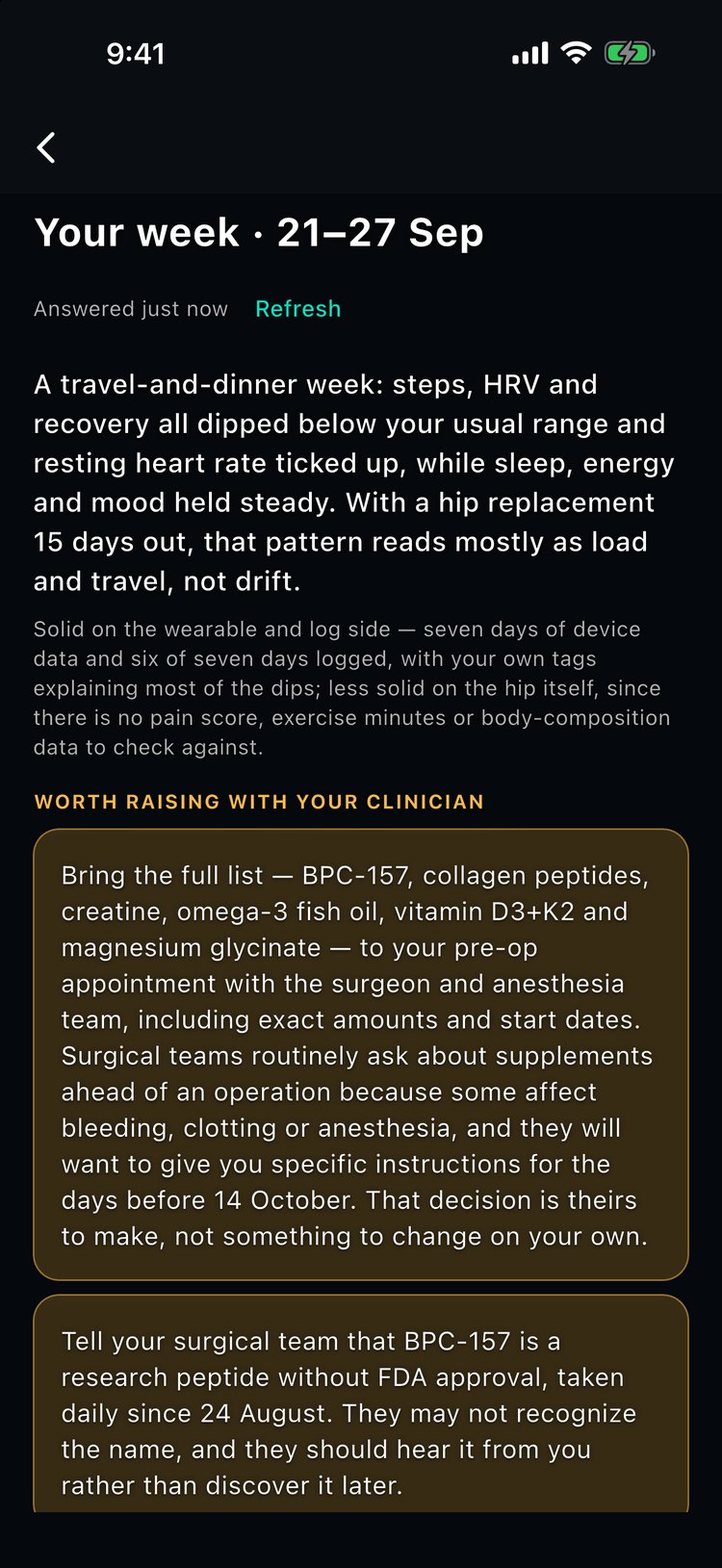
"Solid on the wearable and log side — seven days of device data and six of seven days logged, with your own tags explaining most of the dips. Less solid on the hip itself, since there is no pain score, exercise minutes or body-composition data to check against."

Actual output, from a demo record. Not a mock-up.

An answer that tells you what it couldn't check is worth more than a confident one that doesn't. That's the difference between a record and a guess.

A weekly report: a travel-and-dinner week where steps, HRV and recovery dipped below the usual range, a note on how solid that reading is, and what to raise with the surgical team before a hip replacement

Ask a follow-up in plain language. It keeps your protocol, logs, labs and Health data in front of it the whole time.

Your goal

The same week, read differently depending on what you're chasing.

Most health apps let you pick a goal and then change nothing. Cevren reads your week differently for each one — how you felt counts alongside what your watch recorded — and shows you which inputs it's leaning on, so personalisation is something you can see rather than something we claim.

How you feltyour daily rating
—
Sleepduration and stages
—
HRVagainst your baseline
—
Resting HRagainst your baseline
—
Training loadexercise and active energy
—
Body compositionlean mass and body fat
—
ⓘ In the app

Weighted toward how you felt and how you slept, because your goal is recovery and injury repair.

Illustrative weightings. The app shows yours.

Built and shipping

What's actually in testers' hands today.

Built today

Real protocols, not habits

Doses, units, time-of-day blocks, specific weekdays, on/off cycle windows, and the date you actually started each item — so "since you began X" means something. Medications, peptides, supplements and nootropics sit in one list, grouped by type, and every item opens to a full details page. Blends go in as one item, with the components broken out if you know them and left alone if you don't. Thirty-item stacks are normal here.

Built today

A PDF for your clinician

Your record in a clean PDF to hand your clinician, so the conversation starts from what you actually took and what your panels said, not from memory. Page one sums it up: what you take, what changed, and which labs came back outside range. The full record follows. Add an upcoming procedure and your record points out what's worth raising with the team beforehand.

Built today

Photograph the label

Point the camera at a Supplement Facts panel and the product, serving size and every ingredient come back filled in — including blends and own-brand bottles no barcode database has ever heard of. You check the card before anything is saved. If a label contradicts itself, the app says so rather than quietly picking one.

Built today

Panels read in full

Photograph or upload a lab report. Every marker is extracted with its unit and date for you to check before saving, grouped by panel, flagged when out of range, and recognised as the same test across different labs. Every draw on one axis, against what you were taking at the time.

Built today

Apple Health, in context

Sleep stages, HRV, resting heart rate, steps, active energy and blood oxygen sync automatically, along with body fat and lean mass — because the scale alone can't tell losing fat from losing muscle.

Built today

Oura, connected directly

Wear an Oura ring? Connect it and your sleep stages, HRV, lowest heart rate and Oura’s own readiness score come straight from the ring — including the HRV that never reaches Apple Health — and sit right beside what you took.

Built today

Reconstitution, solved backwards

Enter vial size and the dose you want. Get the water volume and the syringe draw for each option, constrained to what the vial physically holds.

Built today

Reminders that name things

One notification per time block, listing what's actually due — at times you set. Press and hold it to mark doses Taken or snooze them, without opening the app. Miss a day and you can log it back, up to a week.

Built today

Cycles that ask

When a cycle's on-phase ends, Cevren asks: start the rest, or keep going? Answer straight from the lock screen without opening the app. It never puts you back on anything by itself, and every answer is recorded with the date it actually happened.

Built today

Answers that show their work

Ask a question about your own data in plain words. Every answer shows which logs, labs and Health trends it used, with their dates, what it couldn't check, and sources for anything it looked up. Ask what dose ranges people use and you'll see figures from studies, clinical practice and user communities, each labelled with where it came from.

Built today

A Monday report

Turn it on and a short report arrives as a notification every Monday: what you logged, what changed, and what moved against your own usual range. Off unless you want it.

Built today

Tag what was different

Travel, a bad night, alcohol, a hard session: one tap when you log. Months later, those tags are why an odd week makes sense.
Not built yet

What we're working on next.

None of this exists today, and we won't pretend otherwise. No dates either — we'd rather be late than ship something that overstates what it knows.

This list isn't fixed. Testers found the bedtime reminder firing four hours early, and body composition tracking is in the app today because the beta group made the case for it. If you're running a protocol and something here is missing, we'd rather hear it now than after launch.

In the app

What it looks like.

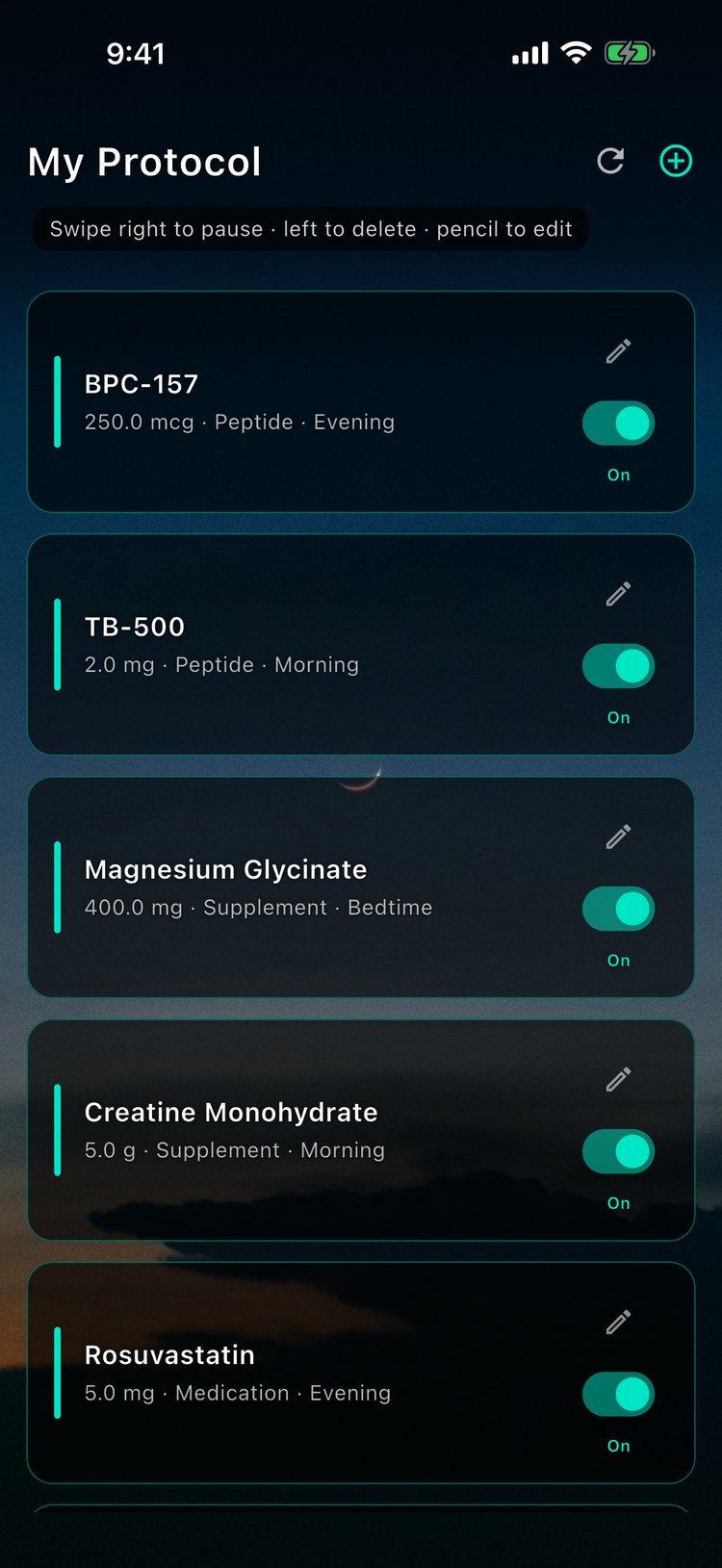
My Protocol: BPC-157 and TB-500 (peptides), magnesium glycinate and creatine (supplements) and rosuvastatin (medication) in one list, each with its dose and time of day
Peptides, prescriptions and supplements. One record.
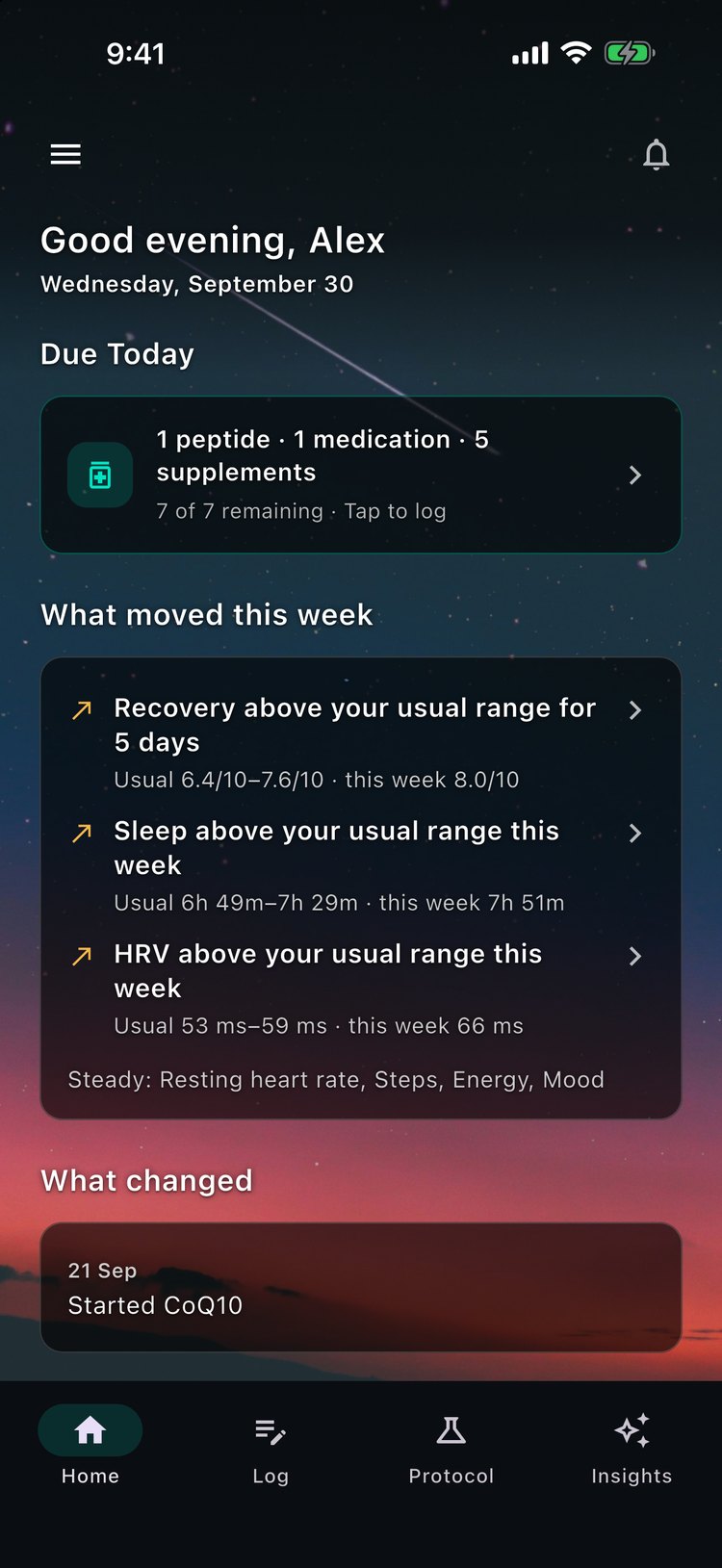
Home: due today, and what moved this week against the usual range: recovery above the usual range for 5 days, sleep and HRV above the usual range this week
What moved this week, against your own normal. No scores to decode.
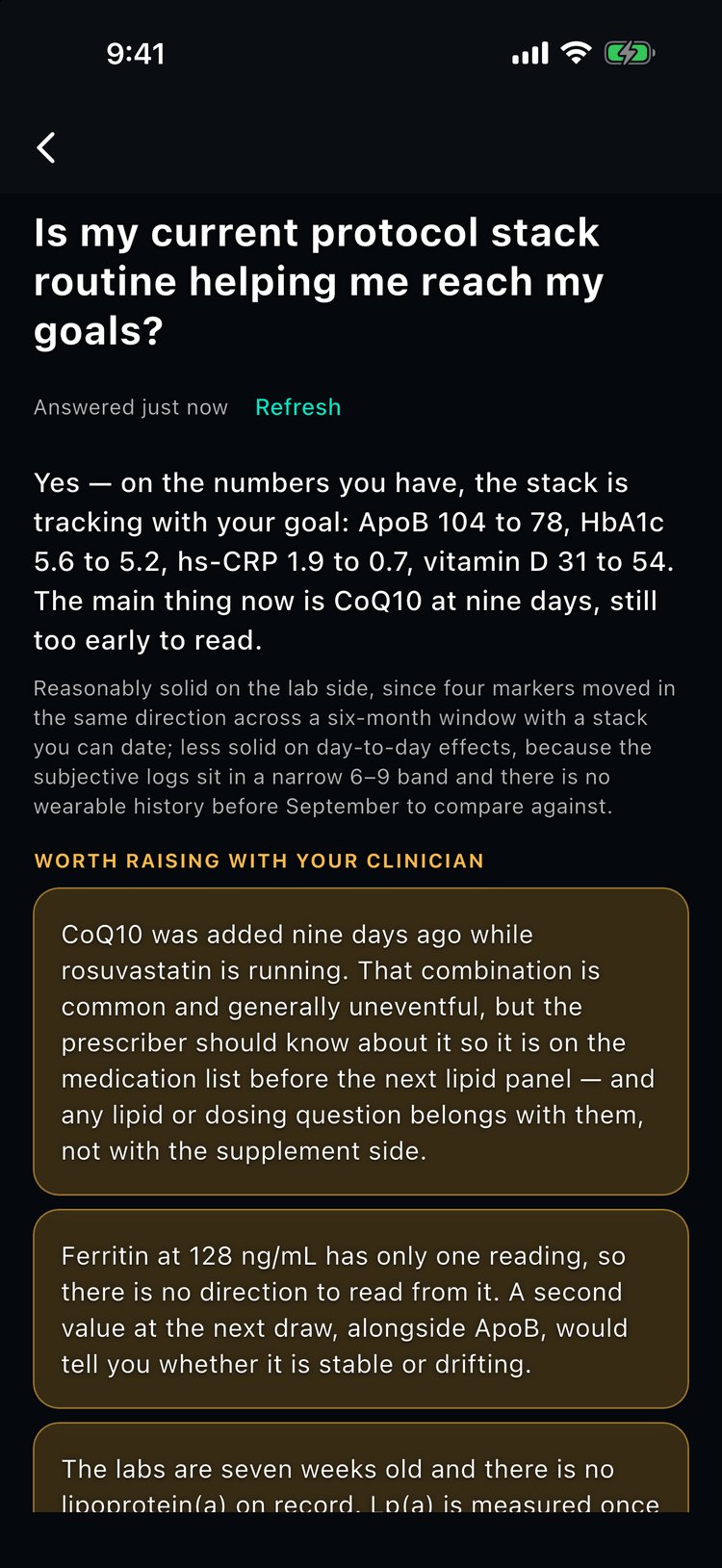
An answer to: Is my current protocol stack routine helping me reach my goals? Yes, on the numbers you have: ApoB 104 to 78, HbA1c 5.6 to 5.2, hs-CRP 1.9 to 0.7, vitamin D 31 to 54; CoQ10 too early to read
Is it working? A straight answer, with the numbers behind it.

Where we draw lines

Five things we deliberately won't do.

This category is full of confident software making claims it can't support. Most of our design decisions have been about what to leave out.

no invented certainty

Other apps will happily tell you a compound "worked." They can't know that. Cevren shows you what moved, when, and what else changed that week — and says so where two changes overlap. Anything more confident is a guess with a chart on it.

no lab grade

We won't score you on "percentage of markers in range." That number improves when you order fewer tests, and reference ranges are population percentiles — not targets.

no invented numbers

When there isn't enough history to say something honest, the app says so. An empty week reads as "building your baseline," never as a confident score.

no disease risk

If we ever read genetic data, it will be to inform what you're already taking. No APOE, no BRCA, no late-onset disease interpretation. That belongs with a genetic counsellor.

no selling

We don't sell supplements, peptides or tests, and we don't take affiliate fees. Cevren has no stake in which compounds you run, so it has no reason to tell you anything other than what your own data shows.

Beta access

The beta is open.

Cevren is built for people already running a protocol, and it's most useful to us in the hands of anyone with a lab report from the last six months: every lab format we haven't seen is a bug we haven't found.

It's a small group. You get direct access to the founder, bug reports get read the same day, and what you ask for changes what gets built next.

iPhone only for now. Free while in beta.

How to join

Tap Join the beta on your iPhone. If you don't have TestFlight yet, Apple's page will ask you to install it first — it's Apple's own app for testing new apps. Once it's installed, go back to that page and tap step 2 (or tap Join the beta here again), then choose Install.

Got it. One email at launch, nothing before.